Sunday, July 25, 2010

Before and After Tetris

Note: I have this blog posted on screwattack.com under the name MisterBo, so if this looks familiar that's probably why. If you want to see blog posts before I post them on blog spot, they will be on screwattack.com.

Probably the only good thing to come out of Russia since Yakov Smirnoff, Tetris is probably the most popular puzzle game ever. There are two notable games I want to talk about, the Tengen version and the Game Boy version. As a quick note, I had to restart this from the ground up because my computer crashed trying to upload this blog, so if it seems rushed, this is why.

Before:
There isn't much of a before to Tetris. While Working at the Soviet Academy of Science, Alexey Pajitnov created a game called Tetris on an Elektronika 60.


"In all its Soviet glory."

After:
The game was eventually ported to the IBM computer and because Alexey couldn't sell the game for himself in Soviet Russia, he gave it away. The game was so widespread it eventually made its way to Budapest, Hungary where Robert Stein "discovered" (I can't even begin to show you how many sarcastic quotation marks I can put around that.) the game and decided to steal the rights and sell them illegally for profit instead of cutting through all the red tape. These "imaginary" rights were sold to Tengen, a side company of Atari, and Spectrum HoloByte. Tengen produced copies of their own version of Tetris for the NES and it was released in May of 1989. The game didn't last on the market for long because of court battles saying that Nintendo had the rights to the game (I'll talk about that in a little bit). The Tengen version of Tetris for the NES is considered the superior version of Tetris when compaired to Nintendo's version for the NES.


"Which one looks better to you?"

Nintendo decided that they wanted to get on the Tetris bandwagon, so they originally approached Robert Stein to give them rights to produce Tetris on the Game Boy. After several months, Nintendo never got their rights, so they went to Russia to visit the company ELORG, a company set up in Soviet Russia to sell the rights of Tetris, and Nintendo showed ELORG the game they made and they had not approved this. To make it up, Nintendo gave ELORG the royalties and in return ELORG gave Nintendo rights to produce the game. When Robert Stein showed up at ELORG he was only given rights to produce Tetris on computers, computers being anything with a monitor and keyboard. This screwed Robert in the ass because already sold those rights to Spectrum HoloByte and the game was widely popular.


- Are you bored?
+ Yeah. Got any ideas?
- Wanna play Tetris?
+ TETRIS! I LOVE TETRIS! YAAAAAAAY!!!!!!!

Later after the Cold War, all the rights of Tetris were given back to Alexey Pajitnov and he founded The Tetris Company in 1996 in the US. This allows Alexey Pajitnov to distribute the rights of Tetris in the US.


"Three cheers for beard man!"

Friday, July 23, 2010

Before and After Pac-Man

Note: I have this blog posted on screwattack.com under the name MisterBo, so if this looks familiar that's probably why. If you want to see blog posts before I post them on blog spot, they will be on screwattack.com.

Considerably one of the best arcade game of all time and one of the worst atari 2600 games of all time, Pac-Man has left a huge impression on the video game world and will probably have the largest chapter in the big book of video game history.

Before:
In 1955, the company of Nakamura Manufacturing was founded in Tokyo, Japan by Mayasa Nakamura. In 1958, the company had a slight name change to Nakamura Facturing Co. which would later be shortened to Namco. In 1970, the company produced a coin-op mechanical simulator called Racer. Atari Japan, a Tokyo based division of Atari, was struggling financially in 1974. Nakamura struck a deal with Nolan Bushnell allowing Namco to buy out the company for 500,000 dollars. Namco ended up inheriting all the debts Atari Japan had, but were able to distribute Atari games for ten years. Because of this deal, Namco opened up a series of arcades with Atari games. In 1978 Namco produced its first original video game, Gee Bee.


"It looks like pinball on crack."

In 1979, Namco revolutionized the video game industry by producing the first video game with RBG color graphics and that game was Galaxian.


"Isn't Galaga, I mean, Galaxian a great game?"

Also in 1979, young Namco employee, Toru Iwatani, was to develop a game over the course of the year. While at a American pizza restaurant, Iwatani was inspired by a missing pizza slice and the Japanese slang phrase paku-paku taberu (paku-paku describes the sound of a mouth opening and closing in succession) to create a character and Pac-Man was born.


"If the dots are pills, does that mean Pac-Man's a junkie?"

After:
The game was originally released in Japan under the name Puck Man in 1980. The game got a lukewarm response due to more popular games such as Space Invaders.


- Captain, we're losing ships, what should we do?
- Drop down, increase speed, REVERSE DIRECTION!!!

Later that year, Bally of Midway manufactured the game under the altered title Pac-Man thinking that vandals would change the P in Puck Man to an F making it "Fuck Man".


"Puck Man sure likes gobbling balls."

The game was a huge success bringing in lots of revenue and creating lots of popularity. It was so good it had a top 40 song named after it called "Pac-Man Fever."


"Video Gamers rejoice!"

The game went on to sell over 350,000 units becoming one of the top selling arcade games of all time. Originally a bootlegged game called Crazy Otto, Ms. Pac-Man was the unofficial sequel to Pac-Man produced by Midway. The game was the original Pac-Man game, but with improvements. This game was also a huge success becoming one of the highest selling arcade games of all time.


"Insert ball joke here."

There are many ports of Pac-Man, but only one I want to talk about. Pac-Man for the Atari 2600, the biggest mistake in video game history. Atari got the rights to produce a port for Pac-Man in the late 1970's. They thought it would be easy to produce the game thinking the game was popular because of it's gameplay and not graphics. They had a prototype ready by late 1981, but to capitalize on the game for the 1981 holiday season, they decided to release the prototype. At the time, there were only 10 million active Atari 2600's being used, but Atari made 12 million copies of the game thinking every Atari 2600 owner would buy the game and 2 million people would buy the system just to play the game with predicted sales to be 500 million dollars. The game only sold 5 million copies leaving 7 million leftover. The game was awful and is often blamed along with E.T. The Extra Terrestrial for the video game crash of 1983."


"Shame! SHAME!!!!!!!!!!!!!!!"

Thursday, July 22, 2010

Before and After Pokemon Red and Blue

Note: I have this blog posted on screwattack.com under the name MisterBo, so if this looks famliar that's probably why. If you want to see blog posts before I post them on blog spot, they will be on screwattack.com.

Finally! I get to talk about my first ever video game. This is somewhat important because I am somewhat of a pokefan, but not so much of a pokefan that I go to tournaments and preorder the anime movies on DVD. Between the ages of four and ten everything having to do with Pokemon was my life. Now, I only play the video games. As a side note, my first ever game, Pokemon Blue, and my first game system, Game Boy Color, was stolen by one of friends. You know who you are, DYLAN, asshole.

Before:
In 1989, the company Game Freak was founded. One of the first games the company produced was Mendel Palace for the NES.


“What the fuck is going on?”

A notable game Game Freak produced is Yoshi which is a puzzle game like a combination between Tetris and Puzzle Bobble where the goal of the game is to get rid of lines of enemy blocks while Mario and Luigi move the columns.


"It must suck being Yoshi's Bitch."

Another notable game the company produced is Pulseman, a game only released for the Sega Genesis in Japan. The game is similar to Megaman X, but there's more free range of movement and the game is much more fast paced.


"He looks Alfalfa from Little Rascals."

In 1996, game programmer, Satoshi Tajiri, was inspired by to create a game from his favorite hobby as a kid, insect collecting. Satoshi Tajiri noticed that kids weren't playing outside as much and stayed home. So, he created the battling and collecting Game Boy games known as Pokemon Red, Blue, and Green.


"What language is the menu in, German?"

After:
The Japanese initially released Pokemon Red and Green on the same day in 1996 and Pokemon Blue was released six months later as a more improved version of the two games. As Game Freak translated the games for the western localization, they realized it was impossible to just replace the Japanese text with English because of the fragile state of the source code. In order to translate the game, it had to be built from the ground up. Also, Nintendo thought that "cute monsters" wouldn't appeal to an American audience, so they suggested the game programmers "beef up" the sprites thinking it would make the game more appealing. In addition to the American release of the Pokemon games, they decided to release only Pokemon Red and Blue in the US and leave out Pokemon Green.


"We get Game Boy and they get SUPER Game Boy! NO FAIR!"

In attempts to sell the game, Nintendo spent over 50 MILLION (that's million with an m) dollars just to promote the games. Despite all setbacks in development, the game were received extremely well in the US. In 2009, The Guiness Book of World Records stated that Pokemon Red and Blue is the best selling RPG for the Game Boy and the best selling RPG of all time. (HOLY SHIT! I didn't know it was that good.) To follow up Pokemon Red and Blue, the game, Pokemon Yellow, was released. The game has your starter Pokemon, pikachu, follow your character making the game like the anime. Also like the anime, the game features anime characters, Jesse, James, and Meowth.


"The rest of the text says, if you know what I mean."

The sequals to Pokemon Red and Blue were Pokemon Gold and Silver for the Game Boy Color. The games are basically the same game as their predecessors, but have more pokemon, better graphics, and different characters.


"Watch out! It's Clefairyzilla!"

The maps of Pokemon Gold and Silver are built upon the original maps of Pokemon Red and Blue with many differences. The trainers are different and there are different Pokemon in different areas.

JohtoKanto.png image by Pkmn_knight
"There really isn't anything I can make fun of here."

I can ramble on and on about all the different Pokemon sequels and remakes that have been made like Pokemon Sapphire. If you want me to get technical, I talk about the remakes, pinball games, puzzle games, home console games, trading card video games, and the Super Smash Bros. series, but that's way too much, so I'll only talk about the remakes. Pokemon Red and Green got remakes for the Game Boy Advanced in America called Pokemon Fire Red and Leaf Green. They follow the same story line as the original games, but with added features such as the sevii islands.


"Those island are as small as your dick."

Pokemon Gold and Silver got remakes for the Nintendo DS in 2010 called Pokemon Heart Gold and Soul Silver. Just like the other remakes, they follow the same storyline as the original, but have added features such as the Pokethlon.

http://img12.imageshack.us/img12/7181/pokethlon3.jpg
"In Japan, the captions aren't edited in, they actually occur in real life there."

The Pokemon series is still going strong today. The recent announcement of Pokemon Black and White, it has Pokefans like me excited and ready to go on the new journey.


I'm pretty disappointed that they didn't talk about this at E3."

Wednesday, July 21, 2010

Before and After Sonic the Hedgehog

Note: I have this blog posted on screwattack.com under the name MisterBo, so if this looks famliar that's probably why. If you want to see blog posts before I post them on blog spot, they will be on screwattack.com.


Before:
In 1940, a company known as Standard Games (later named Service Games) was founded in Honolulu, Hawaii to provide coin-op games for American servicemen to provide entertainment. In 1951 the company moved to Japan and in 1952 Service Games of Japan was registered. In 1954, Rosen Enterprises was founded to export art. The company later found popularity in instant photo booths that they imported, so the company also decided to import coin-op mechanical games. In 1965, Rosen Enterprises and Service Games merged to form Sega Enterprises. One of the first games Sega produced was a submarine simulator called Periscope.


"It's better than playing with shit."

The game was a huge hit worldwide. As the company continued to prosper, it was bought by Gulf+Western. One of Sega's more popular video arcade was Zaxxon which was the first game to use axonmetric projection.


"Why is there a plane on my motherboard?"

In 1983, Sega made it's first home console, the SG-1000, but the system was only available in Japan and Australia.

File:Sega SG-1000 Bock.jpg
"Damn Aussies."

Also in 1983, Sega produced the first ever 3D arcade game SubRoc-3D.


"It looks like someone threw up on the game."

The same year Sega produced the first ever laserdisc game, Astron Belt.


"EXPLOSIONS!"

Sega was a very successful company, but ended up as one of the victims of the video game crash and was bought out in 1984 by CSK and had its new headquarters in Japan. In 1986 Sega of America released the Sega Master System. Even though the Sega Master System was superior to the NES, it didn't appeal to the American mass market. The unofficial mascot for Sega was Alex Kidd who's first game was Alex Kidd in Miracle World.


"Did his hand get stung by a bee?"

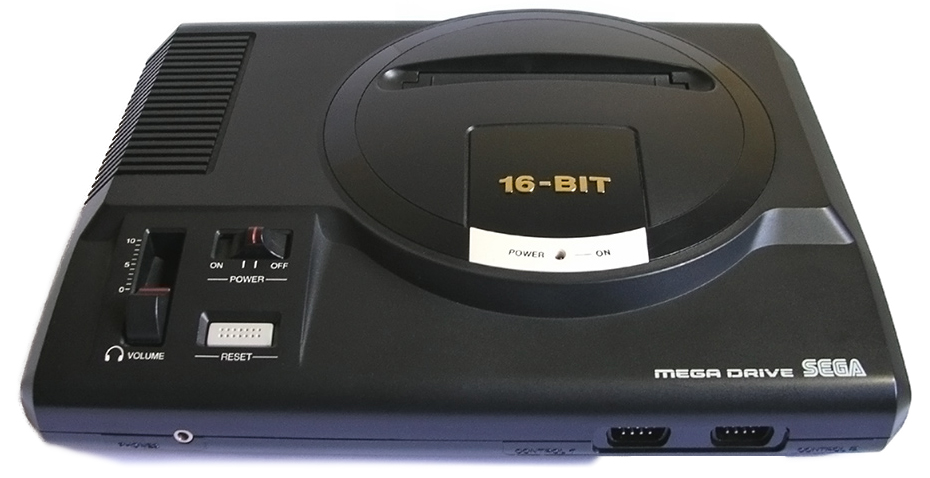
In 1989, Sega released the Sega Genesis or Mega Drive.

File:Megadrive no shadow.jpg
"It's sound system sounds like someone taking a shit on a funk album."

The company used an anti-Nintendo campaign to promote the console.

http://media.giantbomb.com/uploads/0/7464/873617-large_super.jpg
"Genesis does what Nintendon't until 1991."

In 1991, Nintendo released the Super Nintendo, a far more superior console to the Sega Genesis. This caused Sega to change it's slogan to "Welcome to the next level". In the same year Sega decided they needed a new mascot that needed to be "cooler" than Mario. Sega came up with a mascot and that mascot was Sonic the Hedgehog.


"He looked so different back then."

After:
Originally the Sonic we know today was very different than the Sonic that was first planned. Originally Sonic was to be in a band as the lead singer and would be featured in a sound test screen of Sonic the Hedgehog. In addition, Sonic was to have a human girlfriend and fangs, but once the game was given to Sega of America they got rid of all that stuff.


"This makes no sense."

The game was released for the Sega Master System and the Sega Genesis and were extremely popular. The game was later packaged with the Sega Genesis to promote their new mascot. Sonic the Hedgehog featured graphics revolutionary for its time and allowed the player to travel very quickly across the map.


"Before that annoying prick Tails follows you around."

The main point of the Sonic the Hedgehog is to collect the six Chaos Emeralds to prevent Dr. Robotnik from getting them. Each zone has its own chaos emerald until the final zone and at the end of each zone you had to fight a big machine built by Dr. Robotnik with Dr. Robotnik controlling it.


"Look out, its a giant ball!"
"That's what she said."

Sonic the Hedgehog later had a sequal released, Sonic the hedgehog 2. The game features a new playable character, Tails, but who wants to play as him. The main point of the game is to collect the seven Chaos Emerals from the eleven different zones in the game. As you play you will always have Tails follow you and if you manage to finally lose him he'll fly back to you for he's invincible. I have nightmares about him. Once all the emeralds are collected, you go Super Sonic and fly off to the Death Egg to defeat Dr. Robotnik.

Sonic the Hedgehog 2 Screenshot
"No Tails! I don't want you to see me this way."

The sequal to Sonic the Hedgehog 2 is Sonic the Hedgehog 3. This game is the first game to feature Knuckles. The main point of the game is to progress through the six levels, but in order to fully complete the game you must collect the seven Chaos Emeralds. There is an expansion pack that allows you to play as Knuckles in Sonic the Hedgehog 2 and 3 and allows you to explore new areas.


"Who wouldn't play as Knuckles?"

Sega continued to make systems after the Sega Genesis, but they were rushed in order to compete with othe newer systems. They first produced add-ons to the Sega Genesis such as the Sega-CD and 32X, but the games for the system got poor reviews and the add-ons themselves were too damn expensive.


"The video game equivalent to Frankenstein's monster."

Also, the Sega Saturn had the same problems the Sega-CD and 32X had by having crappy games and also the graphics failed in comparison to its competitors such as the PlayStation and Nintendo 64.


"At least its not an Atari Jaguar."

Sega did make a comeback with the Dreamcast, but fans of Sega lost hope of Sega redeeming themselves and the release of the PlayStation 2 didn't help either. Even though the system had good games, low sales caused Sega to discontinue the Dreamcast two years after its release in the US.


" Sega Dreamcast RIP 1999-2001"

Since then, Sega has not produced any new systems, but has remained a 3rd party gaming company producing games for the Wii, Xbox 360, and PlayStation 3. In recent years, there have been a slew of Sonic games that have been crappy, but there is hope. There has been the announcement of Sonic the Hedgehog 4 and is a throwback edition in the Sonic series and is expected to save the series. Also, compared to the original Sonic the Hedgehog the graphic are way more improved to show how far the series has come.

File:Sonic 4 Screenshot.jpg
"Finally! At least he doesn't turn into a werewolf or has a sword."

Tuesday, July 20, 2010

Before and After Final Fantasy

Note: I have this blog posted on screwattack.com under the name MisterBo, so if this looks farmliar that's probably why. If you want to see blog posts before I post them on blog spot, they will be on screwattack.com.

Just being clear, I will talk about the Final Fantasy series as a whole, but mainly covering the best games in the series in my opinion. These games are Final Fantasy, Final Fantasy VI or Final Fantasy III in the US, and Final Fantasy VII. This is going to be a shitload of games, so if you need to use the bathroom, I recommend you use it now.

Before:
There isn't much of a before to Final Fantasy because it was less than five years between when Square started and when Final Fantasy was produced. The company of Square was founded in 1983 by Masafumi Miyamoto. It was originally a subsidiary of the company owned by his father, Denyusha, which was a powerline construction company. They originally made computer games such as The Death Trap.

File:The death trap screen2.gif
[COMMAND] : take piss *enter*
*computer answers* do not know how to take piss.

Originally, Square was reluctant to produce games for home consoles, but they decided to do it. The first game they produced for home systems was Thexder and was only available for the Famicom. The first game square produced for the NES was 3-D Worldrunner.

File:3d worldrunner screen11.png
"It might be 3D but it ain't no Avatar."

The company also produced the more popular game Rad Racer.


"If you're racing aqainst against VW Bugs
of course you'll win!"

Even though the company the company was very sucessful, the had a rush of bankrupcy in 1987 with Rad Racer and 3-D Worldrunner barely keeping the
company afloat. So, as a final farewell, Square game designer, Hironobu Sakaguchi, decided that this would be his "final" game and it would be a "fantasy" hence the name Final Fantasy. The game was released in Japan in 1987 and was released in 1990 in the US.


*Sings Final Fantasy fanfare.*

After:
Final Fantasy featured a new type of battle system letting you battle up to nine enemies at once instead of one at a time like in other RPGs such as Phantasy Star. Also, after defeating an enemy, you are rewarded with experience points, gold, and sometimes items. The combat system is menu based allowing the player to make a selection of an attack out of various options. At the beginning of the game you have the option of choosing four out of six characters that have their own job or class. These classes are fighter, thief, monk or black belt, red mage, white mage, and black mage. Your characters will later be upgraded based on your character choices. Fighters become knights, thieves become ninjas, monks become masters, red mages become red wizards, black mages become black wizards, and white mages become white wizards. The mages and wizards can learn different spells based on which one you choose. The object of the game is to go around the country playing as the fabled light warriors defeating the four fiends to restore the four orbs that each represent a simple element, earth, fire, wind, water, from their current dark state. After restoring the four orbs, a portal opens taking the light warriors 2000 years in the past and they discover that the four fiends sent Garland (now the archdemon Chaos) to the past to create a time loop allowing him to live forever. Now your objective is to fight and defeat Chaos ending the time loop.


"Imagine what Chaos looks like in 16-bit."

The game was very popular in Japan and was released in the US three years later because of the popularity of Enix's Dragon Warrior in America. But because of the large time gap between the release of Final Fantasy in Japan and the US, they already had Final Fantasy II and Final Fantasy III released in Japan but decided not to release them because Square thought it would cause to much confusion. So, to release Final Fantasy IV in America, they put it under the name Final Fantasy II in the US.

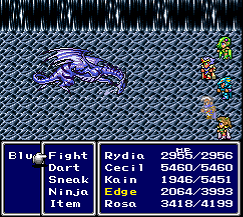
File:Ff4wiki.PNG
"IT'S FINAL FANTASY IV NOT II!"

After Final Fantasy IV, Square produced the sequal Final Fantasy V intending to release it as Final Fantasy III in the US, but the project fell through because Square thought the game didn't appeal to the average gamer.
The sequal to Final Fantasy V, Final Fantasy VI, was released in the US as Final Fantasy III. Final Fantasy VI uses the same battle system as the original Final Fantasy, but you get gil instead of gold. As an addition to the combat system, there is an Active Time Battle system or ATB that times between a charaters attacks. This system was introduced in Final Fantasy IV and is now a Final Fantasy game regular. Also, characters can be equipped with various items known as "relics" that changes a characters status or applies a magical spell in response to being near death. In addition, characters can equip magicite which allows the character to receive Magic Aquisition Points (Magic AP for short) after battles to recieve spells specific to the magicite. One thousand years before Final Fantasy VI, there were three gods known as the Warring Triad were the source of all magic and start the war known as the War of Magi. This released magical enery into the world that turned any person who touched it into an esper, who were the soldiers of the gods. After repenting the war, the Warring Triad turned themselves into stone and gave free will to the espers. Their only request to the espers were to keep their power sealed so it couldn't be misused again, so the espers went to a hidden world taking the statues of the gods with them. About 18 years preceding the game, Emperor Gestahl and his general Kefka discover a weakening in the barrier between the world and take advantage of it by attacking the esper's land eventually capturing several espers. In the game, Gestahl experiments infusing humans and machines with magic by using the espers as a power source. This resulted in Magitek. Kefka was one of the first people infused with magic becoming a prototype for the Magitek Soldiers. This experiment was still in its prototype phase and impaired Kefka's sanity giving him the most hilarious laugh. The Empire is on the verge of discovering magic's full potential, but a group of rebels, known as the Returners, want to overthrow the Empire freeing its territories.


"Final Fantasy even has an opera version"

Final Fantasy VII was originally intended for the Nintendo 64, but lacked the capacity of storage space the game needed so they released it for the Sony Playstation. The game uses rendered polygons instead of 2D sprites and scaled battle sequences to make it more realistic.


"How does he hold things? He has no fingers!"

The story of the game revolves around a claimed formal member of SOLDIER and mercenary, Cloud Strife, who helps several others of the group AVALANCE to stop the corporation Shinra from draining all the planets energy. The antagonist of the game, Sephiroth, is a former member of SOLDIER and reappeared after several years after disappearing in battle which he was concluded to have died. The series continues today with the most recent installment of the series, Final Fantasy XIII, and the recent announcement of Final Fantasy XIV the series is still wildly popular in both Japan and the US. Square eventually merged with Enix to create SquareEnix and they have re-released Final Fantasy through Final Fanatasy VI in america placing each game in its proper order in the series.


"They should release the games for the Virtual Console."

Added 6/19/2010: By request, and I thought it was a great idea, I amgoing to talk about Fianl Fantasy XIII to show how far the series has come. Final Fantasy XIII is the highest selling game in the series to date, but was criticized for being too linear. The game primarily focuses on the world of Cocoon which is a sphere that floats above the suface of Pulse. Both worlds are controlled by mechanical beings with godlike power called the fal'Cie.
They are based around a crystal created by the Maker, a godlike figure. The fal'Cie have the ability of marking the humans that live on Cocoon and Pulse making them their servants, called I'Cie. They are given a "Focus", a task to complete. If the task is completed in time, the I'Cie are turned to crystal. Otherwise, they become mindless monsters called Cie'th. The I'Cie aren't told what to do, but are given visions to interpret. If the I'Cie falter in a quest, they are sent upon by a large mechanical monster called an Eidolon. If the I'Cie defeats these things in battle, the Eidolon fight for them. The I'Cie's transformation to crystal isn't permanent because they can be turned back to human at any time and are given another task by the fal'Cie. Cie'th can be transformed into a different kind of crystal from which other I'Cie can learn their focus and complete it. Both worlds are at war, though at the opening of the game, there hasn't been anyone from Pulse or Cocoon in centuries sincce the last time Pulse invaded. The aftermath of the war left a large hole in Cocoon, which was repaired by pieces of Pulse by the fal'Cie. Cocoon is controlled by the Sanctum goverment, which encouragees the hatred of Pulse. The fal'Cie don't control the humans directly, but make their wishes known by the Sanctum. The Sanctum oversees two military branches known as the Guardian Cops and PSICOM. These special forces deal with anything having to do with pulse. The fal'Cie have given the humans advanced technology, though magic still exists. Tht humans don't have access to the magic that the I'Cie and fal'Cie have, but use distilled chemical forms.


"Look at how far we come."