Showing posts with label Nintendo. Show all posts

Thursday, July 29, 2010

Before and After Wolfenstein 3D

Note: I have this blog posted on screwattack.com under the name MisterBo, so if this looks familiar that's probably why. If you want to see blog posts before I post them on blog spot, they will be on screwattack.com.

One of the best things to ever come from the PC world, the Wolfenstein series isn't as strong as it was 15 years ago, but is still popular. This game has a very interesting story behind its games with the original Wolfenstein being a different type of game from the Wolfenstein today. Also, we can probably all agree that the Wolfenstein series didn't become mainstream until Wolfenstein 3D.

Before:
The company Muse Software was founded by Ed Zaron in 1978. Initially publishing games, the company also produced non-game software such as word processers. In 1981, Muse produced the game, Castle Wolfenstein, for the Apple II and later ported it to DOS, the Atari 8-bit family, and the Commodore 64 thus starting the Wolfenstein series.


“Generic Nazi is generic.”

Castle Wolfenstein is a stealth game taking place during World War II. The main objective of the game is to go around the levels of the castle to find the secret war plans and escape alive. Higher military ranks are achieved with every successful escape starting at Private and ending at Field Marshall. The player is to go around the levels by sneaking past guards, impersonating Nazi soldiers and sometimes even killing opponents if necessary. Castle Wolfenstein was one of the first computer games to have crude, but innovative digitized voices which involved the Nazi guards shouting commands such as “Halt!” (Stop!) and “Kommen Sie!” (Come, you!).

In 1984, Beyond Castle Wolfenstein was released for the Apple II, Atari 8-bit, Commodore 64, and DOS in 1984.


“I’m gonna getcha!”

This game is set in World War II during Hitler’s reign as Chancellor of Germany. The main objective is to go around the levels of the secret bunker in Berlin where Hitler is holding secret meetings with his senior staff. The player must retrieve a bomb that the operatives have placed in the bunker and put it outside the door of the room where Hitler is holding his meeting.

The game is basically the same as its predecessor, but with updates. The guards now use a pass system which the guards periodically call the player to show the correct pass (varies by floor), or offer a bribe. If an incorrect pass is shown or the bribe is rejected due to a lack of money, the guard will attempt to activate the bunker wide alarm or attempt to kill the player.

The company of Muse Software shut down in 1987 allowing the Wolfenstein gaming title to be used without copyright restrictions. Thus, inspired by the Muse Software Wolfenstein games, id Software released the father of first person shooters, Wolfenstein 3D was released for the MS-DOS in May of 1992.


“Go kick a Nazi in the face today.”

After:
Wolfenstein 3D has three episodes to it. The episodes mainly focus on William “B.J.” Blazkowicz’s attempts to escape from Castle Wolfenstein and overthrow the Nazi regime. The first episode, Escape from Castle Wolfenstein, B.J., an Allied spy, was captured while trying to find the plans for Operation Eisenfaust, and was imprisoned in Castle Wolfenstein. B.J. tries to escape the castle prison while taking on SS guards, he then finds himself face to face with the head prison guard Hans Grosse.

The second episode, Operation: Eisenfaust, B.J. discovers that the operation is real and the Nazis are actually creating an army of undead mutants in Castle Hollehammer. B.J. goes into the castle and confronts the mad scientist, Dr. Schabbs, creator of the mutants. The defeat of Dr. Schabbs signals the end of this biological war.

Die, Führer, Die! is the chronologically last episode. Fighting Nazi soldiers and attacking the bunker under the Reichstag, B.J. finds himself against Adolf Hitler equipped with a robotic suit.

The Nocturnal Mission creates a prequel storyline, focusing on Germany’s plans for chemical warfare (Giftkreig). A Dark Secret deals with the pursuit of the scientist responsible for the development of the weaponry. B.J.’s task is to infiltrate the weapons research facility and take down another mad scientist, Dr. Otto Giftmacher (Poison Maker translated to English).

Trail of the Madman takes place in Castle Erlangen. B.J.’s goal in this episode is to locate the maps and plans of the chemical war, guarded by Han’s sister, Gretel Grosse.

The story finally comes to a close in Confrontation, set in Castle Offenbach. The final battle is fought between B.J. and the leader of the chemical war initiative, General Fettgesicht (Fat Face translated to English).

Each episode features ten levels, or missions, which have to be finished sequentially. The game had some drastic changes made to it when ported to the SNES. They made a downgrade in graphics, they switched all Swastikas in the game with crosses and removed Hitler’s moustache along with many other things.


“It’s not as fun killing regular soldiers.”

I’m going to skip over a couple games in the Wolfenstein series to talk about the most recent game in the series. Wolfenstein was released for all retail platforms in August of 2009. The story takes place in the fictional town of Isenstadt which the Nazis took complete control of in order to mine rare Nachtsonne crystals needed to access the “Black Sun” dimension. As the game progresses, things that happen in Isenstadt become very strange like German patrollers are replaced with supernatural creatures along with other things.

The plot is basically the same as every other Wolfenstein game, shoot Nazis and stop them from doing weird supernatural things. Also, like every other Wolfenstein game it takes every Nazi myth and tall tale and cranks the dial up to 11. The whole game itself is like watching a B-rated movie, it was good but you could have missed it. The graphics are amazing compared to Wolfenstein 3D and shows really how far the series has come, but over the years the series has become less popular and doesn’t have the same fan base that it had 15 years ago.


“It’s almost sad really.”

Wednesday, July 28, 2010

Before and After Mega Man

Note: I have this blog posted on screwattack.com under the name MisterBo, so if this looks familiar that's probably why. If you want to see blog posts before I post them on blog spot, they will be on screwattack.com.

I just needed to do this. It's a game that has the most spin-offs of any other game and a lot of sequels. Mega Man has nine sequel and eight spin-offs. Since there is so much to talk about, I will not talk about the spin-offs and will probably talk about them in there own separate blog entries because, except for Mega Man X, the spin-offs have nothing to do with the original series, especially Mega Man Legends. The fucking game takes place in the 81st century, 6000 YEARS FROM NOW. When the original game is said to take place in the year 2009. It's a really messed up series.

Before:
On May 30 1979, the company of Capcom was founded. In 1984, Capcom released their first arcade game Vulgus.


"This game makes less sense than Joust."

Later the same year, Capcom released one of their more popular arcade games was 1942, a side-scrolling shooter.


"The planes! There everywhere!!!"

In 1987, a big year for Capcom, the company released the arcade fighter Street Fighter, one of Capcom's most successful franchises.

File:Street Fighter.png
"Wow! Ryu, I didn't know you dyed your hair red."

The same year, Capcom released the platformer Mega Man for the NES.

Artwork of a dark blue, vertical rectangular box. The top portion reads
"Worst box art ever."

After:
The original Mega Man was released for the NES in December of 1987. The game proceeds the events after the co-creation of the humanoid robot Mega Man by Dr. Light and Dr. Wily. They also created six other robots: Cut Man, Fire Man, Elec Man, Ice Man, Bomb Man, and Guts Man. These robots were for industrial use like building and demolition for the benefit of mankind. Dr. Wily though grows disloyal of his partner and reprograms the six robots to aid his plan to take over the world. This game featured a system revolutionary for its time allowing you to choose what level to start out with and after defeating a Robot Master, you get a weapon similar to the Robot Master's ability. Also the game featured a point system and after beating each level, you received bonus points.


"Where's the run away screaming like a
little girl option?"

After the events of Mega Man, Mega Man 2 was released for the NES in July of 1989 and takes place in the year 200X. Dr. Wily builds a new fortress with eight new Robot Masters: Metal Man, Air Man, Bubble Man, Quick Man, Crash Man, Flash Man, Heat Man, and Wood Man. After defeating the Robot Masters, Mega Man fights and defeats Dr. Wily's holographic projection. After Dr. Wily begs for mercy, Mega Man spares his life. Mega Man 2 features the same level choosing and power-up system, but no longer has the point system. Mega Man 2 is the first game in the Mega Man series to feature a password system and the game features power-ups given to Mega Man by Dr. Light.


"This is so not fair."

The sequel to Mega Man 2, Mega Man 3, was released for the NES in November of 1990 and also takes place in 200X. Dr. Wily has claimed to reformed his evil way and is working with Dr. Light to build a peace-keeping robot named "Gamma". However, the Robot Masters set in charge of the "mining worlds" a crazy and make off with the eight power crystals. Mega Man is called to save the day with his new helper robot dog, Rush, to retrieve the crystals from the mining worlds. After the crystals are collected, Wily steals Gamma and goes to his new fortress. Mega Man goes to the fortress to destroy Gamma. After Mega Man's final confrontation with Wily, the fortress crumbles and Proto Man appears in enough time to save Mega Man, but Dr. Wily was crushed under the rubble. The game features the same power-up and level choosing system from previous games and a password system. Also, Rush has many abilities like to give Mega Man extra jump height and jet.


"Why is a little blue sperm floating towards me?"

The next game, Mega Man 4, was released for the NES in January of 1992 and takes place in the year 20XX. One year after Mega Man 3, Dr. Light receives a letter from Dr. Cossack claiming he is the best robot engineer in all the world. Cossack also states that he will release his army of robots as a "test" for Light to see which one is the best. The next game, Mega Man 4, was released for the NES in January of 1992 and takes place in the year 20XX. One year after Mega Man 3, Dr. Light receives a letter from Dr. Cossack claiming he is the best robot engineer in all the world. Cossack also states that he will release his army of robots as a "test" for Light to see which one is the best. Mega Man is sent to destroy Dr. Cossack's Robot Masters: Ring Man, Dive Man, Skull Man, Bright Man, Dust Man, Drill Man, Toad Man, and Pharaoh Man. Once Mega Man destroys all of the Robot Masters, he makes his way to Dr. Cossack's icy fortress. In the middle of the final battle with Cossack, Proto Man teleports in with Cossack's daughter, Kalinka. Dr. Wily kidnapped Kalinka and convinced Cossack to build an army of robots to fight Mega Man. With the plan uncovered, Mega Man must go through the new castle only for Dr. Wily to escape in the end. This game features the same power-up and password system. The game also features Rush and the first appearance of Flip Top Eddie. The game also gives Mega Man the new "Mega Buster".


"Has anyone seen my helmet?"

Mega Man 5 was released for the NES in December of 1992 and takes place in the year 20XX. Proto Man is discovered to be leading an army of robots in a series of destructive attacks on the world. On top of that, he even kidnaps Dr. Light. Mega Man wonders why his brother is doing this, but does what must do to stop him. After defeating the eight Robot Masters: Stone Man, Gravity Man, Crystal Man, Napalm Man, Gyro Man, Charge Man, Wave Man, and Charge Man, Mega Man makes his way to Proto Man's castle. However, the real Proto Man arrives revealing the robot as Dr. Wily's evil robot, Dark Man. Mega Man destroys Dark Man, goes to Dr. Wily's new fortress, and saves Dr. Light as Wily makes his getaway. Same power-up and password systems as previous games and same old Rush. This game though, features the first appearance of the super weapon Beat.


"I feel like I'm gonna puke." *vomits in corner*

Mega Man 6 was released in March of 1994 and takes place after the events of Mega Man 5. A man known as "Mr. X" hosts the first annual "Robot Masters Tournament" to test the abilities of the world's greatest robot engineers. Dr. Light decides to not enter the tournament, but sends Mega Man to supervise. Near the end of the tournament, Mr. X announces he's reprogrammed the top 8 robots to do his bidding in taking over the world. Dr. Light immediately sends Mega Man to stop the madness. Mega Man defeats the Robot Masters: Blizzard Man, Wind Man, Flame Man, Tomahawk Man, Centaur Man, Knight Man, Yamato Man, and Plant Man, and makes his way to Mr. X's fortress. Mr. X removes his disguise revealing himself as Dr. Wily and he makes his way to his new fortress. After pursuing and defeating Dr. Wily, he is finally sent to prison. Same power- up and password system as in other games, but rush is used as an armor boost to Mega Man and this is the last Mega Man game for the NES.


"Why does HE get a big turret gun and I don't."

Mega Man 7 was released for the SNES in September of 1995 and takes place after the events of Mega Man 6. I'm not going to explain the backstory so I'll get on to the plot. Wily always knew that he would be imprisoned someday, so he built 8 back-up Robot Masters: Junk Man, Spring Man, Burst Man, Cloud Man, Freeze Man, Shade Man, Slash Man, and Turbo Man. If the Robot Masters don't receive a communication within six months, they will go searching for their master. It has been six months, so they have been released and go on a rampage looking for Dr. Wily. Mega Man is called into action and gives chase, but is stooped by Bass. Bass has capabilities much like Mega Man and has his own robotic wolf, Treble. After a brief battle, Bass says that they both are trying to stop Wily and teleports off confusing Mega Man, but convinces him that he has a new ally. In one of the locations of the Robot Master's, Mega Man discovers an injured Bass and takes him back to Dr. Light's lab for repairs. Mega Man then defeats the remaining Robot Master's and upon returning home, he discovers that Bass went berserk and took some enhancement parts that Dr. Light was working on. Wily appears on the video monitor and says that Bass and Treble are his own creations and only gained Mega Man's trust to steal the parts. Bass' ambition though is to beat Mega Man in battle to declare himself the strongest robot in existence. Mega Man makes his way to Wily's new fortress and defeats Bass, Treble, and Dr. Wily himself. Mega Man says he is finally going to kill Dr. Wily, but Dr. Wily says he can't hurt humans because he is a robot. Mega Man says he is "more than a robot" and prepares to kill his nemesis, but is interrupted by the fortresses self-destruction. Bass comes to Dr. Wily's rescue and takes him out of the fortress and Mega Man also makes his way out of the fortress also.
The game features the same power-up and password system as the NES games and Rush is the same as Rush in Mega Man 3. The only main innovation is the improved graphics and the boss system where you have to defeat the first four bosses before defeating the next four.


"Let me guess, do you have a little bird super
weapon named Time Signature?"

Mega Man 8 released for the PlayStation and Sega Saturn in February of 1998. The game opens with a battle in space with two alien robots who eventually plummet towards Earth critically injured. Meanwhile, Mega Man and Rush go to investigate strange energy reading on a nearby island. On the island, Mega Man finds Dr. Wily flying away with a strange purple orb, but before chasing him, Mega Man sees a damaged robot and asks Dr. Light to repair it. Dr. Wily then releases four new Robot Masters and after defeating one, Mega Man receives a purple orb like the one Dr. Wily had. Each of the Robot Masters have a strange energy that Dr. Wily has infused them with. After defeating all four robots: Tengu Man, Astro Man, Sword Man, and Cloud Man, Dr. Light tells Mega Man the robot should be fine after some rest. After they leave the lab, the robot wakes up, sees the purple orb, and flies out of the lab enraged. Mega Man follows the robot to a mine shaft on the other side of the globe. After battling the robot, Proto Man comes and tells Mega Man that his new fortress, "Wily Tower", is just ahead, but is caught by one of Wily's robotic creations trying to get there. The robot saves him and says his name is Duo. Duo explains that the purple orbs are "Evil Energy", and he has been tracking down this energy around the universe trying to destroy it before it engulfs the entire world. However, Wily has a barrier around his new fortress, and Duo tells Mega Man to destroy the four other Robot Masters: Search Man, Frost Man, Grenade Man, and Aqua Man, while he destroys the rest of the world's energy. Once the Robot Masters are defeated, the barrier is lifted from Wily Tower and Mega Man makes his way through it eventually defeating Bass and Dr. Wily himself. The "Evil Energy" is destroyed before it spread through the world, and the fortress is demolished with Mega Man inside who is infected with the "Evil Energy". Duo arrives and cures Mega Man of the Evil Energy seemingly getting rid of all the Evil Energy in the world. This game is different from other Mega Man games by having a save system, anime cutscenes, and voiced character sprites. The game though had the same weapon system as in other games.


"I recall Aqua Man not being a big ugly robot."

Mega Man 9 was released for the WiiWare and PlayStation Network in September of 2008 and was released for Xbox Live Arcade in October of 2008. Dr. Light is blamed for a robotic rampage and Dr. Wily apparently has no connection to it. Dr. Wily announces he needs money to complete the robots he built to combat those of Dr. Light. Mega Man vows to fight to prove Dr. Light's innocence and to expose Wily's intentions. After defeating a certain Robot Master, a piece of scrap metal is left behind revealing that the robots are due for recycling. Mega Man eventually receives the last Robot Master's memory chip which reveals that Dr. Wily vowed to save the robots from their expiration date and he reprogrammed them. Before the information becomes public, Wily swoops in and steals the chip in his flying saucer. Mega Man fights and defeats Wily, who immediately begs for forgiveness. Mega Man scolds him by using Rush as a projector to show Wily's begging for forgiveness from previous Mega Man games. Mega Man discovers that Wily is responsible for arresting Dr. Light and that he has fallen ill. Then, Proto Man comes in to warn Mega Man that the seemingly ill Dr. Light is just an impostor used for the news footage. Mega Man takes his chances with Wily, and while he's disabled with Wily's fortress coming down on him, Proto Man swoops in to save him. Wily escapes and Dr. Light is freed returning everything back to normal. The eight Robot Masters: Concrete Man, Tornado Man, Magma Man, Galaxy Man, Hornet Man, Plug Man, Jewel Man, and Splash Woman, are reprogrammed and work along Dr. Light and his other robots. This game is a throwback Mega Man game that involves saving the game and doesn't use Rush, Beat, or Eddie as power-ups. Also, you can buy Proto Man and use him as a playable character in the game.


"I'm getting to old for this shit."

The most recent Mega Man game, Mega Man 10, was released for WiiWare, PlayStation Network, and Xbox Live Arcade in March of 2010. A robotic illness known as Roboenza starts infecting robots, making them malfunction, with Roll as one of the victims. A month following the outbreak, a bunch of robots go berserk and try to take over the world. These robots are Sheep Man, Commando Man, Blade Man, Strike Man, Solar Man, Chill Man, Nitro Man, and Pump Man. Dr. Wily comes to Mega Man and Dr. Light saying that he had a machine to develop and make a cure until an infected robot stole it. Mega Man decides to help Dr. Wily to retrieve the machine and runs into Proto Man, who decides to join him. Meanwhile, Bass sets out on his own challenge to destroy the robots to prove that he's the strongest. Mega Man is halfway to finishing his journey when Dr. Wily develops a prototype antidote, and gives it to Roll. After defeating all eight Robot Masters, Mega Man appears to have caught Roboenza. Dr. Wily then appears on television to say that he created the virus and he only developed a cure to bribe other all the infected robots to work for him. Roll then gives Mega Man her medicine and says that she was waiting for "a really sick robot was brought in". Mega Man takes Roll's medicine so that he can defeat Dr. Wily and bring back enough medicine for everyone. During the attack on the fortress, Proto Man comes down with Roboenza and Mega Man gives him an extra sample of the cure that he acquired. A similar incident happens to Bass, but the only difference is that Treble is the one who gives him the cure. After chasing Wily from his fortress to his space base and defeating him once again, our heroes discover that he's ironically very ill. Unable to let him die, they take Wily to a nearby hospital where he is cured and escapes a few days later. Surprisingly, Wily leaves enough of the cure behind to cure all of the infected robots. This Mega Man game also features a save system and allows the usage of Rush during gameplay. Other Playable characters that can be purchased are Proto Man and Bass.

Mega Man 10 Screenshot
"Why me?"

The Mega Man series has come a long way from it's NES days producing a whole bunch of spin-off series, arcade games in Japan, and remakes. Also as an honorable mention, the Mega Man series even had its own line of game boy games similar in gameplay to the NES games. The Blue Bomber is still going strong today and the only thing that could be the cherry on top of the Mega Man sundae is putting him in a Super Smash Bros. game.


"It could happen."

Also, the series inspired its own cartoon in the 80's, an anime, and fan film that can be found on the website. In my opinion, the cartoon is hilariously bad, the anime is okay, and the fan film gets a thumbs up.


"Yeah, it's that bad."

Tuesday, July 27, 2010

Before and After The Legend of Zelda

Note: I have this blog posted on screwattack.com under the name MisterBo, so if this looks familiar that's probably why. If you want to see blog posts before I post them on blog spot, they will be on screwattack.com.

Probably one of the best video games on the NES, The Legend of Zelda is another masterpiece produced by the video game master Shigeru Miyamoto. The series itself is great, but the time line in really confusing. Mainly I'll talk about the original The Legend of Zelda, The Legend of Zelda: A Link to the Past, The Legend of Zelda: Ocarina of Time, and The Legend of Zelda: Twilight Princess.

Before:
With the Nintendo's success of Super Mario Bros., Shigeru Miyamoto and his team were to create an adventure game different from Mario. His team came up with ideas and put them into two catergories, Mario and non-Mario. Inspired by his childhood adventures of traveling through the forests of Japan, Shigeru Miyamoto came up with a non-linear adventure game using the non-Mario ideas. Also, he thought of the first name of American author F. Scott Fitzgerald's wife, "Zelda" Fitzgerald as part of the title. The game is now known today as The Legend of Zelda.


"In video games, Link = Shigeru Miyamoto."

After:
Every The Legend of Zelda game has basically the same goal. Go through dungeons, collecting items, and save the Princess Zelda, but every game has a different place in the time line with different game play, a different Link, and a different Zelda. The first The Legend of Zelda was released for the NES in 1987. In The Legend of Zelda, you play as Link traveling around different dungeons collecting the pieces of the Triforce of Power, defeat Ganon, and save Princess Zelda.


"I'm sorry Link, but your princess is in another dungeon."

The only Zelda game released for the SNES, The Legend of Zelda: A Link to the Past, was released for the SNES in 1992. In this game, Link saves Princess Zelda and travels around the Light World to receive the three magic pendants, but Zelda is kidnapped again and sent to the Dark World by the evil wizard Agahnim to break the seal to free Ganon because she's one of the seven descendants of the Seven Sages. Now, Link must go to the Dark World to save the seven descendants of the Seven Sages, battle and defeat Agahim and Ganon, and restore the world to the way it was before Ganon.


"Looks like link has a big white cock."

The next and probably the best game for Nintendo home consoles is The Legend of Zelda: Ocarina of Time. This is the first 3D Zelda game and was released for the Nintendo 64 in November of 1998. You start out as Young Link in the Kokiri Village and is sent the fairy, Navi, and is summoned by the Great Deku Tree who tells link that me must stop the "wicked man of the desert", or Ganondorf, from taking over the world. Now, Link has to collect the three spiritual stones, the Kokiri Emerald, the Goron Ruby, and the Zora Sapphire. After collecting the spiritual stones, Princess Zelda is seen pursued on horseback by Ganondorf and teaches Link the Song of Time telepathically and gives link the Ocarina of Time. Link places the spiritual stones in the Temple of Time and plays the Song of Time and Link opens a door recieving the Master Sword. Then, Links wakes up seven years in the future as Adult Link and Link is told by one of the sages to awaken the other six sages with the assistance of Sheik. Once Link awakens five of the sages, Link fights and defeats Ganon and the Seven Sages seal him. Also, Sheik reveals she's Princess Zelda and the seventh sage and send's Link back seven years so he can live out his childhood.


"Now Link has a big white cock in 3D."

The most recent installment of the Zelda series for a home console is The Legend of Zelda: Twilight Princess and it was released for the Gamecube and Wii in November of 2006. In this game, you have to save your friends and Princess Zelda from the Twilight Realm. While in the Twilight Realm, Link turns into a wolf and is followed by Midna who leads Link to the Mirror of Twilight. After a series of dungeons, you have to battle and defeat Ganondorf and then the Mirror of Twilight is destroying the last gateway between the Twilight World and the Light World.


"It's better than polygons."

Now, gamers are anticipating the release of The Legend of Zelda: Skyward Sword, the newest game announced for the Zelda series. I know I've ignored the hand held games and the games featuring Toon Link, but I want to show how far the series has come story and graphic wise.

File:Zeldaskywardsword2010E3.png
"Link, in technicolor!"

Sunday, July 25, 2010

Before and After Kid Icarus

Note: I have this blog posted on screwattack.com under the name MisterBo, so if this looks familiar that's probably why. If you want to see blog posts before I post them on blog spot, they will be on screwattack.com.

I thought I'd talk about this because of the recent announcement of Kid Icarus: Uprising and E3. The games I'm going to talk about are the original NES version and Kid Icarus: Of Myths and Monsters for the Game Boy. Until Kid Icarus: Uprising is released, the games I'm going to talk about are the only games in the series.

Before:
During the 80's, Nintendo was having lots of success with platformer games on the NES such as Super Mario Bros. and The Legend of Zelda. To follow up this success, Nintendo released Metroid. I know I said I was going to talk about Kid Icarus, but just bare with me.


"Still can't believe Samus is a woman."

The game was released for the Famicom in 1986 and it was released for the NES a year later. Nintendo tried to separate Metroid from other games by making it a nonlinear adventure-based game. Along with The Legend of Zelda, Metroid helped pioneer the idea of permanent power-ups that are needed to complete the game. In The Legend of Zelda, it's the flute, and in Metroid it's the missile. Also, the game had a password system where typing in certain password, like JUSTIN BAILEY, can alter gameplay.


"Awesome. Just awesome."

Metroid was programmed alongside another game and shares certain elements with Metroid. Kid Icarus was developed as Metroid's sister game.


"Sister? Really?"

After:
Like Metroid, Kid Icarus was released for the Famicom in 1986 and was released for the NES a year later. The game is said to combine elements from Nintendo's three biggest franchises - Mario, Zelda, and Metroid. Pit is able to jump like Mario, he's object driven like Link, and is able to shoot like Samus. The backstory of the game is that Palutena, the Goddess of Light, gave light to the mortals to cultivate crops, but Medusa, the Goddess of Darkness, dispised the mortals and destroyed their crops and turned them into stone. Angered, Palutena transformed Medusa into a dark monster and banished her to the Underworld, but she didn't go quietly. While in the Underworld, Medusa formed and army to attack the Palace in the Sky, Palutena's home. Medusa's minions overwhelmed Palutena's army and eventually imprisoned the Goddess of Light and retrieved the Three Sacred Treasures, the Mirror Shield, the Arrow of Light, and the Wings of Pegasus entrusting one of these treasures to three of her strongest minions. Palutena's only hope was Pit, an angel trapped in the Underworld, and with the last of her strength, Palutena sent Pit a magical bow. Pit then set out on a quest to escape from the Underworld, retrieve the Three Sacred Treasures to defeat Medusa , rescue Palutena, and restore peace to the Angel Land.


"Why is it always one person who has to save
the world and not an army or at least two people!"

There are 5 different endings, the first three ending include normal sized Pit being given a helmet signifying a certain job. The fourth ending features Pit being transformed into a full-grown angel. The last ending is Pit being transformed into a full grown angel and is only achieved by having all power-ups and hearts.


"Why doesn't he have to go through puberty."

Also, like Metroid, Kid Icarus had a password system with pre-programmed passwords that could alter gameplay, like ICARUS FIGHTS MEDUSA ANGELS.
Which gives the player invincibility and unlimited feathers.


"Shout for help and get lots of items."

Using the same engine as Metroid II: The Return of Samus, Kid Icarus: Of Myths and Monsters was released for the Game Boy in 1991. Listen up kids, it backstory time! One night, the Goddess Palutena had a dream where Angel Land was attacked by an army of demons, again. She summons a soothsayer and he tells her that it was not just a dream, but it would soon come to pass that demons named Orcos would attack Angel Land. Pit was then summoned the Three Sacred Treasures, the Wings of Pegasus, the Silver Armor, and the Light Arrows, so that when the time comes, he's able to defeat the Orcos. Later, we find out that there is only one demon named Orcos, but the manual makes references to it being several demons. Also, Pit will run in to Zeus in the game who tests his strength and will grant Pit a special weapon if he passes the test of endurance. Also, the game doesn't have a password system, but a save system with continues or credits. If you run out of credits you're taken back to your last save point.


"It even worse than Medusa!"

It's been almost 20 years since the last Kid Icarus game and I with the announcement of Kid Icarus: Uprising for the Nintendo 3DS and the feature of Pit in Super Smash Bros. Brawl, it's safe to say that Pit is making a comeback. Now, all we need is a Final Fantasy VII remake.


"Finally!"

Before and After Tetris

Note: I have this blog posted on screwattack.com under the name MisterBo, so if this looks familiar that's probably why. If you want to see blog posts before I post them on blog spot, they will be on screwattack.com.

Probably the only good thing to come out of Russia since Yakov Smirnoff, Tetris is probably the most popular puzzle game ever. There are two notable games I want to talk about, the Tengen version and the Game Boy version. As a quick note, I had to restart this from the ground up because my computer crashed trying to upload this blog, so if it seems rushed, this is why.

Before:
There isn't much of a before to Tetris. While Working at the Soviet Academy of Science, Alexey Pajitnov created a game called Tetris on an Elektronika 60.


"In all its Soviet glory."

After:
The game was eventually ported to the IBM computer and because Alexey couldn't sell the game for himself in Soviet Russia, he gave it away. The game was so widespread it eventually made its way to Budapest, Hungary where Robert Stein "discovered" (I can't even begin to show you how many sarcastic quotation marks I can put around that.) the game and decided to steal the rights and sell them illegally for profit instead of cutting through all the red tape. These "imaginary" rights were sold to Tengen, a side company of Atari, and Spectrum HoloByte. Tengen produced copies of their own version of Tetris for the NES and it was released in May of 1989. The game didn't last on the market for long because of court battles saying that Nintendo had the rights to the game (I'll talk about that in a little bit). The Tengen version of Tetris for the NES is considered the superior version of Tetris when compaired to Nintendo's version for the NES.


"Which one looks better to you?"

Nintendo decided that they wanted to get on the Tetris bandwagon, so they originally approached Robert Stein to give them rights to produce Tetris on the Game Boy. After several months, Nintendo never got their rights, so they went to Russia to visit the company ELORG, a company set up in Soviet Russia to sell the rights of Tetris, and Nintendo showed ELORG the game they made and they had not approved this. To make it up, Nintendo gave ELORG the royalties and in return ELORG gave Nintendo rights to produce the game. When Robert Stein showed up at ELORG he was only given rights to produce Tetris on computers, computers being anything with a monitor and keyboard. This screwed Robert in the ass because already sold those rights to Spectrum HoloByte and the game was widely popular.


- Are you bored?
+ Yeah. Got any ideas?
- Wanna play Tetris?
+ TETRIS! I LOVE TETRIS! YAAAAAAAY!!!!!!!

Later after the Cold War, all the rights of Tetris were given back to Alexey Pajitnov and he founded The Tetris Company in 1996 in the US. This allows Alexey Pajitnov to distribute the rights of Tetris in the US.


"Three cheers for beard man!"

Tuesday, July 20, 2010

Before and After Final Fantasy

Note: I have this blog posted on screwattack.com under the name MisterBo, so if this looks farmliar that's probably why. If you want to see blog posts before I post them on blog spot, they will be on screwattack.com.

Just being clear, I will talk about the Final Fantasy series as a whole, but mainly covering the best games in the series in my opinion. These games are Final Fantasy, Final Fantasy VI or Final Fantasy III in the US, and Final Fantasy VII. This is going to be a shitload of games, so if you need to use the bathroom, I recommend you use it now.

Before:
There isn't much of a before to Final Fantasy because it was less than five years between when Square started and when Final Fantasy was produced. The company of Square was founded in 1983 by Masafumi Miyamoto. It was originally a subsidiary of the company owned by his father, Denyusha, which was a powerline construction company. They originally made computer games such as The Death Trap.

File:The death trap screen2.gif
[COMMAND] : take piss *enter*
*computer answers* do not know how to take piss.

Originally, Square was reluctant to produce games for home consoles, but they decided to do it. The first game they produced for home systems was Thexder and was only available for the Famicom. The first game square produced for the NES was 3-D Worldrunner.

File:3d worldrunner screen11.png
"It might be 3D but it ain't no Avatar."

The company also produced the more popular game Rad Racer.


"If you're racing aqainst against VW Bugs
of course you'll win!"

Even though the company the company was very sucessful, the had a rush of bankrupcy in 1987 with Rad Racer and 3-D Worldrunner barely keeping the
company afloat. So, as a final farewell, Square game designer, Hironobu Sakaguchi, decided that this would be his "final" game and it would be a "fantasy" hence the name Final Fantasy. The game was released in Japan in 1987 and was released in 1990 in the US.


*Sings Final Fantasy fanfare.*

After:
Final Fantasy featured a new type of battle system letting you battle up to nine enemies at once instead of one at a time like in other RPGs such as Phantasy Star. Also, after defeating an enemy, you are rewarded with experience points, gold, and sometimes items. The combat system is menu based allowing the player to make a selection of an attack out of various options. At the beginning of the game you have the option of choosing four out of six characters that have their own job or class. These classes are fighter, thief, monk or black belt, red mage, white mage, and black mage. Your characters will later be upgraded based on your character choices. Fighters become knights, thieves become ninjas, monks become masters, red mages become red wizards, black mages become black wizards, and white mages become white wizards. The mages and wizards can learn different spells based on which one you choose. The object of the game is to go around the country playing as the fabled light warriors defeating the four fiends to restore the four orbs that each represent a simple element, earth, fire, wind, water, from their current dark state. After restoring the four orbs, a portal opens taking the light warriors 2000 years in the past and they discover that the four fiends sent Garland (now the archdemon Chaos) to the past to create a time loop allowing him to live forever. Now your objective is to fight and defeat Chaos ending the time loop.


"Imagine what Chaos looks like in 16-bit."

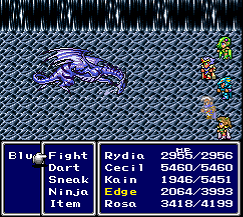
The game was very popular in Japan and was released in the US three years later because of the popularity of Enix's Dragon Warrior in America. But because of the large time gap between the release of Final Fantasy in Japan and the US, they already had Final Fantasy II and Final Fantasy III released in Japan but decided not to release them because Square thought it would cause to much confusion. So, to release Final Fantasy IV in America, they put it under the name Final Fantasy II in the US.

File:Ff4wiki.PNG
"IT'S FINAL FANTASY IV NOT II!"

After Final Fantasy IV, Square produced the sequal Final Fantasy V intending to release it as Final Fantasy III in the US, but the project fell through because Square thought the game didn't appeal to the average gamer.
The sequal to Final Fantasy V, Final Fantasy VI, was released in the US as Final Fantasy III. Final Fantasy VI uses the same battle system as the original Final Fantasy, but you get gil instead of gold. As an addition to the combat system, there is an Active Time Battle system or ATB that times between a charaters attacks. This system was introduced in Final Fantasy IV and is now a Final Fantasy game regular. Also, characters can be equipped with various items known as "relics" that changes a characters status or applies a magical spell in response to being near death. In addition, characters can equip magicite which allows the character to receive Magic Aquisition Points (Magic AP for short) after battles to recieve spells specific to the magicite. One thousand years before Final Fantasy VI, there were three gods known as the Warring Triad were the source of all magic and start the war known as the War of Magi. This released magical enery into the world that turned any person who touched it into an esper, who were the soldiers of the gods. After repenting the war, the Warring Triad turned themselves into stone and gave free will to the espers. Their only request to the espers were to keep their power sealed so it couldn't be misused again, so the espers went to a hidden world taking the statues of the gods with them. About 18 years preceding the game, Emperor Gestahl and his general Kefka discover a weakening in the barrier between the world and take advantage of it by attacking the esper's land eventually capturing several espers. In the game, Gestahl experiments infusing humans and machines with magic by using the espers as a power source. This resulted in Magitek. Kefka was one of the first people infused with magic becoming a prototype for the Magitek Soldiers. This experiment was still in its prototype phase and impaired Kefka's sanity giving him the most hilarious laugh. The Empire is on the verge of discovering magic's full potential, but a group of rebels, known as the Returners, want to overthrow the Empire freeing its territories.


"Final Fantasy even has an opera version"

Final Fantasy VII was originally intended for the Nintendo 64, but lacked the capacity of storage space the game needed so they released it for the Sony Playstation. The game uses rendered polygons instead of 2D sprites and scaled battle sequences to make it more realistic.


"How does he hold things? He has no fingers!"

The story of the game revolves around a claimed formal member of SOLDIER and mercenary, Cloud Strife, who helps several others of the group AVALANCE to stop the corporation Shinra from draining all the planets energy. The antagonist of the game, Sephiroth, is a former member of SOLDIER and reappeared after several years after disappearing in battle which he was concluded to have died. The series continues today with the most recent installment of the series, Final Fantasy XIII, and the recent announcement of Final Fantasy XIV the series is still wildly popular in both Japan and the US. Square eventually merged with Enix to create SquareEnix and they have re-released Final Fantasy through Final Fanatasy VI in america placing each game in its proper order in the series.


"They should release the games for the Virtual Console."

Added 6/19/2010: By request, and I thought it was a great idea, I amgoing to talk about Fianl Fantasy XIII to show how far the series has come. Final Fantasy XIII is the highest selling game in the series to date, but was criticized for being too linear. The game primarily focuses on the world of Cocoon which is a sphere that floats above the suface of Pulse. Both worlds are controlled by mechanical beings with godlike power called the fal'Cie.
They are based around a crystal created by the Maker, a godlike figure. The fal'Cie have the ability of marking the humans that live on Cocoon and Pulse making them their servants, called I'Cie. They are given a "Focus", a task to complete. If the task is completed in time, the I'Cie are turned to crystal. Otherwise, they become mindless monsters called Cie'th. The I'Cie aren't told what to do, but are given visions to interpret. If the I'Cie falter in a quest, they are sent upon by a large mechanical monster called an Eidolon. If the I'Cie defeats these things in battle, the Eidolon fight for them. The I'Cie's transformation to crystal isn't permanent because they can be turned back to human at any time and are given another task by the fal'Cie. Cie'th can be transformed into a different kind of crystal from which other I'Cie can learn their focus and complete it. Both worlds are at war, though at the opening of the game, there hasn't been anyone from Pulse or Cocoon in centuries sincce the last time Pulse invaded. The aftermath of the war left a large hole in Cocoon, which was repaired by pieces of Pulse by the fal'Cie. Cocoon is controlled by the Sanctum goverment, which encouragees the hatred of Pulse. The fal'Cie don't control the humans directly, but make their wishes known by the Sanctum. The Sanctum oversees two military branches known as the Guardian Cops and PSICOM. These special forces deal with anything having to do with pulse. The fal'Cie have given the humans advanced technology, though magic still exists. Tht humans don't have access to the magic that the I'Cie and fal'Cie have, but use distilled chemical forms.


"Look at how far we come."

Monday, July 19, 2010

Before and After Super Mario Bros.

Note: I have this blog posted on screwattack.com under the name MisterBo, so if this looks farmliar that's probably why. If you want to see blog posts before I post them on blog spot, they will be on screwattack.com.

Just to be clear, this is the NES Super Mario Bros. not to get confused with the Mario Bros. arcade game for you dumbasses out there.

Before:
To begin our journey, we must travel far into the past to the year 1977. This is the year where a young Shigeru Miyamoto starts his journey as a video game developer at Nintendo in Japan. His first video game that he worked on was a game called Radar Scope for arcades. It was released in 1979 in Japan and 1980 in the US. The game can be described as a cross between Space Invaders and Galaga.

http://images.webmagic.com/klov.com/screens/R/xRadar_Scope.png
"Pretty colors."

Unfortunately, the game was a commercial failure in America, but popular for a short time in Japan. Since the game was no bueno, Shigeru Miyamoto was given the task to "fix" the game so it would appeal to more gamers. Instead of just fixing the game, he created a entirely new game based off the hardware of Radar Scope. This game is now known in America as Donkey Kong. The game itself was created because Nintendo was trying to create a Popeye arcade game, but lost the copyrights. So out of laziness to not create a new game, the main character, Popeye, became Jumpman or Mario who was a carpenter, Olive Oyl became The Lady/Pauline, and Bluto became a gorilla. The inspiration for Jumpman came from the landlord of the company.

http://dmacmichael.files.wordpress.com/2010/02/donkey-kong-cross-tensions.jpg
"I didn't know Popeye had a moustache."

There are myths out there that say that Donkey Kong was originally supposed to be titled by another name. One myth says that Shigeru Miyamoto used a Japanese-English dictionary to find something that meant "stuborn gorilla" and "Donkey" conveyed "stuborn" and "Kong" was Japanese slang for "gorilla".Another myth says that the game was supposed to be called "Monkey Kong" but got misspelled or misinterpreted in a phonecall or bad fax. Whatever happened, the game became a huge success in the US and Japan being ported to system from the Apple II to the Nintendo 64. There are also clones of the game produced by Sega and Tiger Electronics. As a follow-up to Donkey Kong, the arcade game Mario Bros. was produced. The protagonist in the previous game, Jumpman, was renamed Mario and was now a plumber instead of a carpenter. Mario was also given a brother, Luigi, who was also a plumber and they were investigating the sewers of New York to go after the strange creatures down there.

http://www.ilovethe80s.com/mario_brothers.jpg
"Remember not to flush turtles down the toilet kids!"

This game was the start of the Mario series, and like Donkey Kong, it was wildly popular being ported to many systems. To follow up the lines of popular arcade games, Nintendo decided to release a cartridge based home console in Japan in 1983 called the Famicom.

http://www.vgmastersclub.com/images/nes/Famicom.jpg
"How can this be an NES? I don't know."

Even though after a recall of the system because of a bad chip that caused the games to crash, the system became a huge success in Japan. In 1985, Nintendo released the American version of the Famicom calling it the Nintendo Entertainment System or NES for short.

http://brunksondikes.files.wordpress.com/2009/10/nes-console.jpg
"I can hear the beeps and boops just thinking
about it."

The system on its release had 18 launch titles and one of these titles is Super Mario Bros.

http://upload.wikimedia.org/wikipedia/en/thumb/1/13/Bowser_%28smb1%29.png/200px-Bowser_%28smb1%29.png
"If you were lazy, you took the warp
zone like me"

After:
After the release of Super Mario Bros., Nintendo had what Borat calls "great sucess." Nintendo finally had a mascot for their company. In Japan, a remake of Super Mario Bros. was released in short supply based on the All Night Nippon radio show having the enemies and other characters looking like people involved with the radio show and famous DJs and musicians of Japan at the time.

http://static.gamesradar.com/images/mb/GamesRadar/us/Other/Features/2008/0212%20Cameos/WII20.feat.pic1--article_image.jpg
"This is what Mario sees when he has a mushroom."

Also, there were sequals to Super Mario Bros. such as the imfamous Super Mario Bros. 2. This game was different in Japan and the US. In Japan the game looked like a direct sequal to the original Super Mario Bros..

http://blog.mlive.com/manzero/2007/10/large_20071001-supermariobroslostlevels.jpg
"I like that game."

Unfortunately, this game wasn't released in America until 1993 in Super Mario All Stars under the name Super Mario Bros. The Lost Levels. The Super Mario Bros. 2 that was released in the US was the remake of a Famicom game in Japan called Doki Doki Panic and replaced the original cast of characters with Mario, Luigi, Peach, and Toad.

http://images.icanhascheezburger.com/completestore/2009/2/21/128797356678621202.jpg
"I don't like those games. They suck."

Since I don't have the time to talk about all the Mario games, I'll just talk about the last Super Mario Bros. sequal on the NES, Super Mario Bros. 3.
This is considered one of the best Mario games of all time.

http://selectstartgames.files.wordpress.com/2009/07/super-mario-bros-3-e_011.png
"Hallelujah!"

This game had many innovations in the Mario franchise such as having more stages in levels, mini games, and new power-ups such as the "Tanooki Suit"
and the "Big Leaf". There are many other video games featuring Mario. Some good, some good as shit. But the Mario franchise is still going on strong still producing games that are selling in the millions. There is no doubt that Mario has had a very large impact on the video game industry and helped put Nintendo in the position it is today. Now, to close this article, time to have Mario stare into your soul.

MarioSMBW.png
"All obey Mario!"